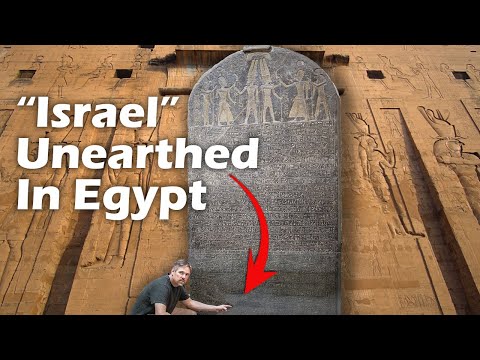
Merneptah Stele
What Was Found
A black granite stele over 3 meters (10 feet) tall, carved for Pharaoh Merneptah in the fifth year of his reign (ca. 1208 BCE). Discovered by Sir W. M. Flinders Petrie at Merneptah's mortuary temple in Thebes in 1896 and first translated by Wilhelm Spiegelberg. The stele primarily celebrates the pharaoh's military victory over the Libyans, but its final lines contain the earliest known extra-biblical reference to "Israel" — reading "Israel is laid waste — its seed is no more." The hieroglyphic determinative used for "Israel" marks it as a people rather than a city-state or territory, indicating that Israel existed as a recognized ethnic group in Canaan by the late 13th century BCE. This single line has made it one of the most important artifacts in Biblical archaeology, establishing a firm historical anchor for the emergence of Israel. The stele is housed in the Egyptian Museum, Cairo (catalog JE 31408).
The Text Itself
Israel is laid waste — its seed is no more.— W.M. Flinders Petrie, "Six Temples at Thebes, 1896" (London: Bernard Quaritch, 1897); Michael G. Hasel, "Israel in the Merneptah Stela," Bulletin of the American Schools of Oriental Research 296 (1994), 45-61
Why This Matters
The earliest known mention of "Israel" outside the Bible, establishing that Israel existed as a recognized people in the ancient Near East by ca. 1208 BCE.
Acceptance Assessment
Universally Accepted
The reading of "Israel" on the stele is universally accepted among Egyptologists and biblical scholars. The stele's authenticity and dating are not disputed.
What Scholars Debate
The main debate is not about the reading of "Israel" (which is settled) but about what it implies for Israelite origins and the Exodus chronology. The determinative marks Israel as a people (not a place), which some scholars interpret as evidence that Israel was not yet a settled state.